
Why Your Flatbed Applicator Needs a Heating Roller
If you run a signage, large-format printing, or graphic finishing shop, you've asked this before: Do I really need a heating roller on my flatbed applicator?
The short answer is yes — especially if you want professional, durable, bubble-free results. Here's the full breakdown, with real-world context from the LeFu flatbed applicator lineup.
What a Heating Roller Actually Does
A heating roller is a temperature-controlled roller (on LeFu models, 0–60°C / 0–140°F, with optional higher temp upgrades) that warms both the lamination film and the substrate as they pass under pressure. It works hand-in-hand with the pneumatic system to activate adhesives and conform films tightly to surfaces.
5 Reasons a Flatbed Applicator Needs a Heating Roller
1. Activates Thermal (Hot-Melt) Adhesives
Many commercial laminates, vehicle-wrap overlaminates, and rigid-board films use heat-activated adhesive. At room temp they're dry; apply 40–60°C and the glue wets out for a permanent bond. No heat = weak bond = edge lift.
2. Stronger Bond on Rigid & Textured Substrates
Foam board, PVC, aluminum composite, acrylic — these don't play nice with cold pressure alone. Heat softens the film so it wraps into texture and edges. LeFu's 130mm premium silicone roller distributes that heat evenly across up to 50mm thick boards for a wrinkle-free finish.
3. Kills Bubbles and Trapped Air
Warm film is more elastic. Combined with pneumatic pressure, air escapes instead of locking in. LeFu B4-series users consistently report "no snowflakes, no bubbles" even on 3.2m-wide jobs.
4. Wider Material Compatibility
With heat you can run:
Thermal laminating films
Reflective & cast vinyls
Outdoor-rated overlaminates
Thick rigid panels up to 50mm (LeFu LF1325-B4 / LF1732-B4 / LF1736-B4 all support this)
Cold-only machines lock you out of most outdoor-grade work.
5. Faster Throughput, Faster Cure
Hot bond sets immediately. No dwell time, no waiting — finished boards go straight to trim or ship. On a busy shop floor, that's real money.
Where LeFu Flatbed Applicators Fit In
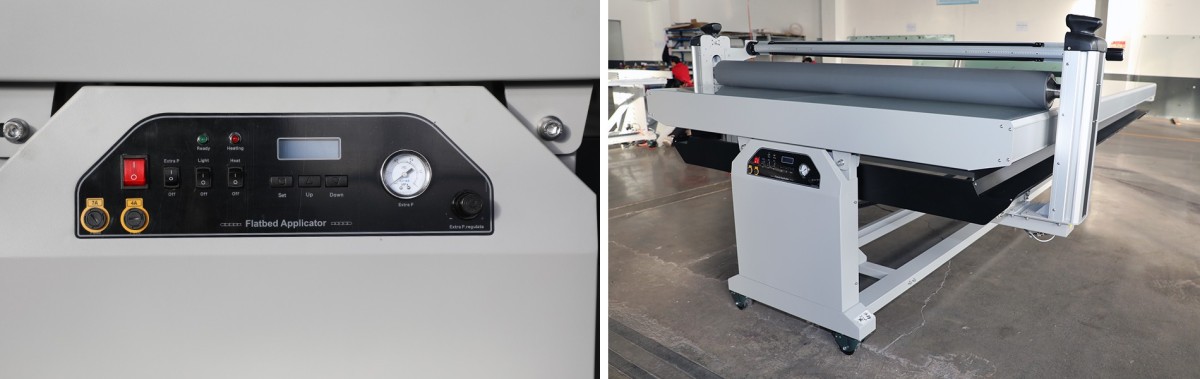
LeFu's LF1325-B4, LF1732-B4, and LF1736-B4 warm-and-cold flatbed applicators are built around this exact principle:
Heated upper silicone roller (130mm dia., 0–60°C standard, 120°C optional)
Pneumatic roller lift with dual-side controls
Intelligent LCD panel to dial in temp + pressure per job
Under-table LED for translucent alignment
Tilted bed to save floor and freight space
Handles 1300×2500mm up to 1600×3200mm sheets, 50mm thickness
In other words, the heating roller isn't bolted on as an afterthought — it's the centerpiece of the lamination zone.
When Can You Skip Heat?
Only for:
Short-term indoor posters (<30 days)
Pure pressure-sensitive cold films
Heat-sensitive foams that deform >60°C
Everything else — outdoor signage, floor graphics, A-boards, vehicle panels — benefits from heat.
Bottom Line
A flatbed applicator without a heating roller is a cold-press machine with a ceiling. Add a properly controlled heated roller (like LeFu's 130mm silicone system), and you unlock thermal films, stronger bonds, zero bubbles, and faster jobs.
If you're buying once and buying to grow, spec the heated roller. LeFu's B4 series is a ready-made example of how to do it right.
Explore the LeFu LF1325-B4 / LF1732-B4 / LF1736-B4 warm flatbed applicators for 0–60°C lamination on rigid and flexible media.
Inquiry
Send Us A Message
CHAIDONG
Professional generator set manufacturer
24/7 before-sales and after-sales services
Comprehensive technical support